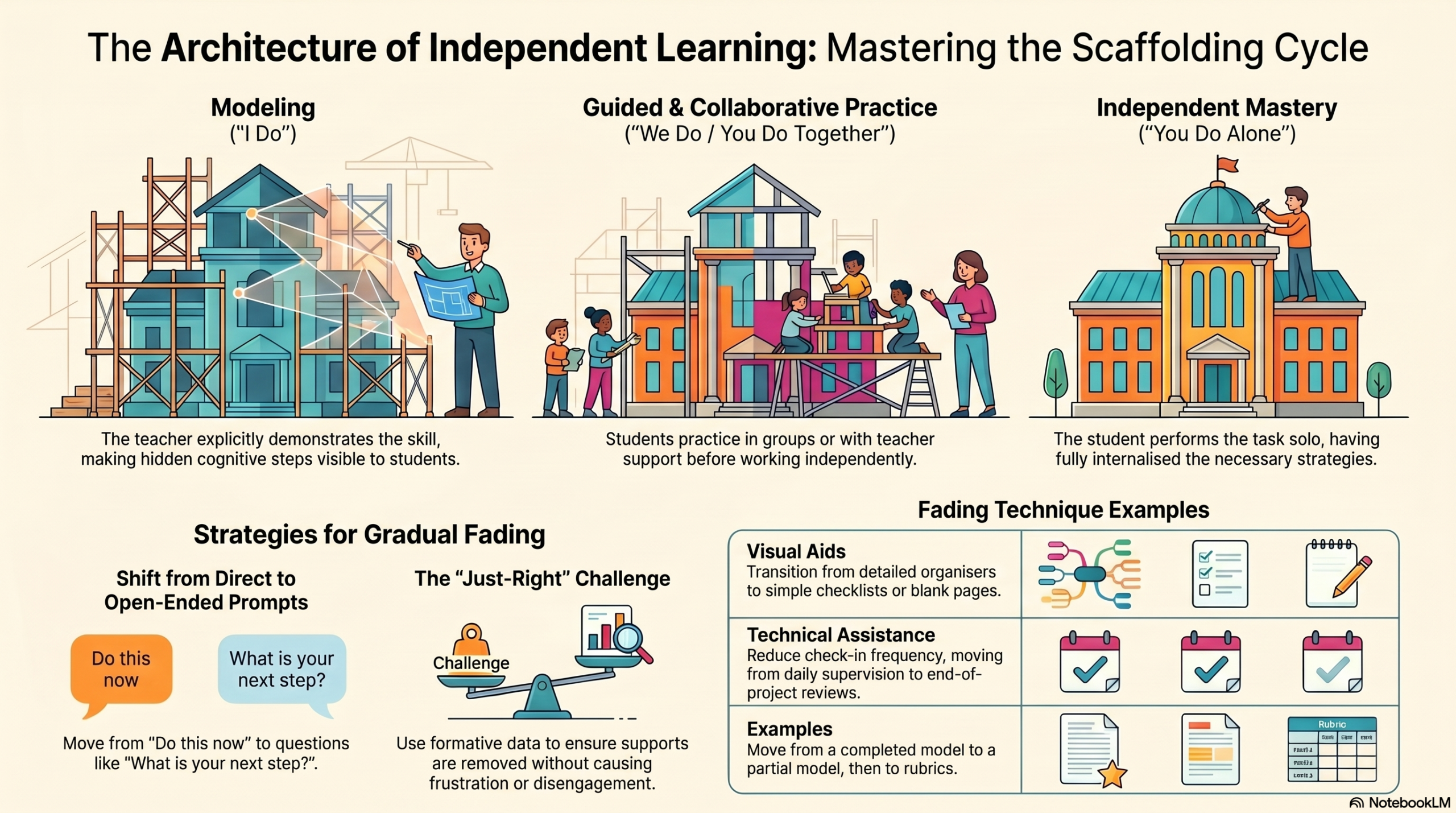
Scaffolding is a temporary instructional structure that provides students with the support they need to master a new skill, with the ultimate goal of removing that support as the student gains independence. This process, often called “fading,” is critical for building self-efficacy and ensuring that students do not become dependent on external help.
1. The Scaffolding Cycle
Effective scaffolding follows a predictable arc that transitions the responsibility from the teacher to the learner.
- Modeling (“I Do”): The teacher explicitly demonstrates the skill or process, thinking aloud to make hidden cognitive steps visible to students.
- Guided Practice (“We Do”): The teacher and students work together, with the teacher providing substantial support and prompts.
- Collaborative Practice (“You Do Together”): Students practice the skill in small groups, with the teacher acting only as a facilitator or “coach” who intervenes only when necessary.
- Independent Mastery (“You Do Alone”): The student performs the task independently, having internalized the necessary strategies and knowledge.
2. Strategies for Gradual Fading
The key to successful scaffolding is to remove support incrementally, ensuring the student is always at the edge of their current ability.
| Scaffolding Type | Fading Technique |
| Visual Aids | Transition from detailed graphic organizers to simple checklists, and eventually to blank planning pages. |
| Verbal Prompts | Move from direct instructions (“Do this now”) to open-ended questions (“What is your next step?”). |
| Technical Assistance | Reduce the frequency of check-ins during a project, moving from daily supervision to end-of-project reviews. |
| Examples | Provide a fully completed model, then a partially completed one, and finally just the rubric for evaluation. |
3. Supporting Diverse Learners
Scaffolding is essential for inclusivity, as it provides a structured pathway for students who may have executive functioning challenges or anxiety.
- Predictability: Scaffolding provides a clear “map” of the learning process, which reduces the anxiety of the unknown for neurodivergent students.
- Individualized Fading: Recognize that “fading” does not look the same for every student. Some may require more time at the “We Do” stage, while others may be ready for independence more quickly.
- Building Resilience: By gradually increasing the challenge and decreasing the support, you help students build the confidence to manage difficult tasks without feeling overwhelmed.
4. Monitoring the “Just-Right” Challenge
If support is removed too quickly, students may become frustrated and disengage; if it is kept too long, they may lose interest or fail to develop true mastery.
- Formative Data: Use frequent, low-stakes checks (like exit tickets or quick demonstrations) to assess whether a student is truly ready for the next level of independence.
- Student Self-Assessment: Empower students to gauge their own readiness by asking, “Do you feel confident enough to try this step on your own, or do you still need a reminder?”.
- Responsive Adjustments: Be prepared to “re-scaffold.” If a student struggles after support is removed, it is okay to step back into a more supportive role momentarily to reinforce the foundational understanding.
Reflection
The goal of scaffolding is to make yourself obsolete in the learning process. In your courses for kids, what is one “scaffold” that you could gradually fade out as the students become more comfortable with the lesson?